Friday, October 24, 2008

The Good Kind of Social Drama


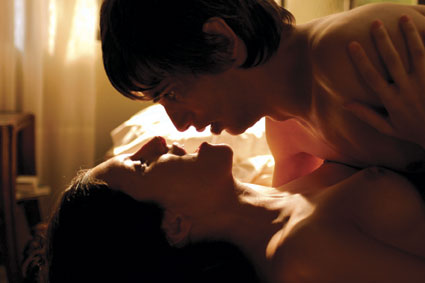
The Noise in My Head plays Saturday at 3pm and Sunday at 5:45pm. Both screenings are at 600 North Michigan.

We’ve all met women like Laura, but rarely in the movies. Early thirties, single, smart but unimaginative, reticent but prone to explode in an argument, pretty enough to date but never married. She works at a big business in a small city (Geneva, in this case) but always in a low-ranking job; even she could not see herself in a position of authority. She shows traces of perfectionism and yet is fundamentally unsure of herself. In fact, she's often in danger of emotional collapse, but avoids it by holding fast to the safety of conformism. With the exception of a sympathetic ex-boyfriend boyfriend, Laura is without companionship. In fact, she doesn’t appear to have anyone in her life with whom she can speak openly. Her unarticulated thoughts have been suppressed for so long they’ve accumulated to a near-schizophrenic din. (They’re the source of this movie’s title, by the way.)

When a woman like her turns up in a fiction film, she’s typically someone’s ex or a family member avoided except for at gatherings. The Noise in My Head is notable for following Laura as her life teeters but doesn’t fall off completely. Given its lack of sensationalism—Laura isn’t out-and-out mentally ill (though she comes close)—the film is not a piece of radical humanism like Lodge Kerrigan’s Keane (2005). Also, the intimate, realistic approach precludes the grand catharsis of a fantasy like Punch-Drunk Love (2003). It resides the squarest of genres, the modest social drama, whose frequent manipulativeness have made it something of an anathema to serious moviegoers. But The Noise in My Head doesn’t want to manipulate its audience. It simply wants to remind us of something that is worth remembering: just how difficult life can be for most people.

The film enters into a plot when Laura lunges impulsively at happiness. She takes in an 18-year-old boy she meets hawking papers on the street. He’s neither violent nor on the make sexually—two clichéd developments the movie thankfully avoids—but a different kind of risk. We come to learn he’s a pathological liar and a bit of a thief, a behavior problem for so long that his parents finally kicked him out. His name is Simon, and we’ve met people like him, too, working at convenience stores and other menial jobs. He’s the sort of kid who wasn’t forward enough in school to be a bully, but he wasn’t smart enough to be recognized as a student, either.

Director Vincent Pluss charts their relationship carefully, finding value in their everyday activities. More characters enter the film and each is as three-dimensional as the leads, giving way to a grand pathology of passive despair. It’s worth noting that Pluss, a young Swiss director still finding his voice, borrows only the best elements of other filmmakers. Taking Mike Leigh’s practice of allowing the actors to help sculpt the dialogue, he creates a comparably deep sea of humanity. Also, his anxious, propulsive editing recalls two masters of modern French cinema, Olivier Assayas and Arnaud Desplechin. But Pluss displays a sympathy for his characters (and a curiosity about the world) that cannot be faked. And he knows how to end a film miraculously. The Noise in My Head stops on a narrative caesura so unexpected and yet so carefully calibrated it reminded me of Flannery O’Connor’s short fiction, another storyteller who inspired awe before life’s possibility.

Thursday, October 23, 2008

Discovery: SERBIS


Serbis plays again on Saturday at River East at 7:30pm.

While I’ve seen some very good movies at the festival, Brillante Mendoza’s Serbis is the first one that threw me for a curve. It’s an in-your-face drama about an extended family that once operated three movie palaces in the Filipino city of Angeles but now runs only one—and that became a second-run porn theater some time ago. The subject matter recalls Tsai Ming-liang’s Goodbye Dragon Inn (2003) and Jacques Nolot’s Porn Theater (2002), but this is not a lament over the death of cinema or the failure of lonely people to connect. The environment is boisterous in spite of the depravity (As in the Tsai and Nolot films, the theater hosts a vibrant a gay cruising culture), full of life, full of character. Mendoza's mobile, mainly hand-held camera seems unable to keep up. The film takes place over an especially busy day as the family’s controlling matriarch awaits a decision in the bigamy suit she’s filed against her husband. Also, her teenage nephew is afraid to announce he’s gotten his girlfriend present; the local pre-op transsexual hookers are working harder than usual to get customers; and someone needs to take the kids to school. For all the melodramatic elements, Mendoza stages the proceedings as if he were Ridley Scott making an action film: We’re constantly in the middle of things. Remarkably, the camera is nonjudgmental throughout all of this, even during the movie’s most prurient moments. (Note to the squeamish: One of them is a hardcore scene involving someone’s popped boil.)

This is Mendoza’s seventh film in four years, and his fearlessness and sure hand with actors (particularly child actors) mark him as a major filmmaker. Serbis played in competition at the Cannes Film Festival this year, where it shocked a good part of the audience. Last night’s screening wasn’t as scandalous (though there were some "Well, I never" kinds of entertaining walk-outs), but it also provoked the realization that Mendoza is someone to watch. I’ll write more about this after Saturday’s screening, which I eagerly await.

Wednesday, October 22, 2008

The Writings on the Wall


24 City plays again tomorrow, 10/23, at River East at 8:50pm.

After seeing more than half-a-dozen or so movies at any festival, one starts seeing patterns in the selections, overlapping themes. It’s always risky to lunge at generalizations about The State of World Cinema or (grander yet) What the World’s Thinking About. Better to regard the experience as a private optical illusion—the magic reassembly of disparate films into a cohesive whole.

That said, almost everything I’ve seen so far at CIFF has involved somebody losing their job. The exceptions—Sleep Dealer, Don’t Look Down, Delta, and 24 City—have involved people accepting menial labor. Comparisons to the global economic crisis are so obvious they don’t need to be spelled out… except these movies were conceived at least a year in advance, by artists working in different countries with different agendas. How legible was the writing on the wall?

Of the movies I’ve watched concerning unemployment, only one has incorporated failure in its overall aesthetic strategy: Kiyoshi Kurosawa’s Tokyo Sonata. The CIFF program aptly describes it as a quiet drama about an average Japanese family—just barely avoiding an allusion to Yasujiro Ozu—and so it is until the final half-hour, when it operates in a sort-of narrative free-fall, with each new development seeming to come from a different movie. Before then, it is a compelling, but somewhat familiar look at a family in crisis, with the central story concerning the businessman father who’s too proud to admit he’s been laid off. The film follows his wife and two children (well-meaning misfits both) separately, so to stress how alienated they’ve become from one another. In its structure and patient, long takes, Tokyo Sonata has less in common with Ozu than with Edward Yang’s Yi Yi (2000), the greatest contemporary family film; and like Yang’s great accomplishment, understated humor tempers the melancholy of Modern Life. But then there’s the final 30 minutes. Without giving away too much, it forces the audience to switch from thinking about a family in crisis to what it means to lose everything—home, relations, one’s very sanity. It’s been less than a day since I watched Tokyo Sonata, and I’m still undecided as to whether its plot twist is brilliant or merely a great trick. Either way, I hope it returns to Chicago with a proper run so I can see it again.

Tuesday, October 21, 2008

From Mexico (and the future): SLEEP DEALER


Sleep Dealer plays again Wednesday, 10/22, at 600 North Michigan at 8:30pm.

In a few generations, migrant workers will no longer need to cross the U.S. border for menial jobs: They can perform them from home with the use of virtual reality. That’s one of the ideas floating around Alex Rivera’s Sleep Dealer, a Phildickian sci-fi story that approaches a high-tech future from the perspective of Mexican laborers. As a film, Sleep Dealer is sometimes flat and too indebted to the Hollywood storytelling it aims to subvert. But as a think piece, it’s clever and endlessly imaginative. During a warm-hearted Q-and-A after tonight’s screening, Rivera admitted to spending 11 years on the project from conception to final cut; he clearly made great use of the time by realizing his future world down to the smallest details. (The intravenous modem cables that connect Mexican workers to U.S. job sites also enable a new form of writing whereby users upload their thoughts like video files. We come to learn that the movie itself is one such “novel.”) One measure of the film’s success is that it’s able to touch on big, relevant subjects—U.S. corporations privatizing water sources in the Third World, the military outsourcing combat duty—without making them seem extraneous to its fictional universe. The may characters may seem a bit transparent as a result, but, as in some of Dick’s best novels, Sleep Dealer still works as a funhouse mirror of current events, with the characters serving to help us explore the variegated terrain. The second and final screening would count as a must-see if Rivera is in attendance again. Animated, honest, and blessed with seemingly bottomless optimism, Rivera has the potential to become the Wayne Coyne of American independent cinema.

A visual essay on Steve McQueen's HUNGER

There's still one more screening of Hunger (2008) at 8:30pm tonight. If you miss it, don't fret: IFC has plans to release the film Stateside in the very near future.

Possibly the most arresting film about prisoners since A Man Escaped (1956), Hunger invokes so many different types of images that it's hard to define director Steve McQueen's achievement in words. There's barely any dialogue in the film -- one crucial several-minutes-long scene excepted -- and as such it seems appropriate to express feelings about it using images. Here goes:

1. 


Francis Bacon (1909 - 1992): Three Studies for a Crucifixion - 2 (1962)

2.


Imperial War Museum archives: Bergen-Belsen, Germany, 1945

3.


Bill Viola (1951 - ): Ocean Without a Shore (2007)

4.


A chamber in Her Majesty's Prison Maze, Northern Ireland

+++

5.


Still from Alan Clarke's Elephant (1989) -- Side A (companion film)

6.


Still from Hunger (2008) -- Side B

7.


Monday, October 20, 2008

Tough Decisions

In the first four days of the festival we had, in competing time slots, two films about pickpockets (The Pleasure of Being Robbed and Sparrow), two films about physical transformation (Beautiful and Hunger), and two important directors doing their sole Q&A's (Darren Aronofsky and Mike Leigh). In pure must-see terms, the new films by Abdel Kechiche, Kelly Reichardt, and Erick Zonca were competing on Friday as a run-up to the even more painful scheduling of 24 City, Of Time and the City, and Gomorrah in simultaneous slots on Saturday.

This may register as a complaint. In fact, it isn't. A cinephile faced with the luxury of having to decide between the new Jia Zhang-ke and Kiyoshi Kurosawa films, not to mention the lesser-known titles that don't come with the same level of critical support, should feel as though at a luxury dinner banquet. Tough choices are a part of festival life, and the more information available to the discerning cinephile, the more discerning his or her choices will be.

A serious discernment should consider the films themselves and never the projection standards, since one always hopes that those will be consistently excellent; however, a few discerning cinephiles have not been pleased the festival's digital projection, and had they been able to discern in advance that 24 City, to take one example, would be shown in subpar conditions, they would have certainly opted for another title.

Theater five and six at the River East, specifically, are the two screens in question. This reviewer spent four hours of Saturday with two films that should have looked a whole lot better: the aforementioned 24 City and Shanghai Trance by Dutch filmmaker David Verbeek. Different in mood though similar in dealing with a contemporary post-industrial backdrop, you wouldn't have been able to tell their visual designs apart if you saw them at this weekend's screenings. With theater five's dark and off-calibrated projection, they both looked muddy and indistinct.

It should be noted that the critics on this blog (and elsewhere) get into the movies for free. We're hardly the ones to complain. This isn't about us. But at the screening of 24 City, the couple who paid $12 sitting next to this critic made their aggravation seem perfectly understandable.

Sunday, October 19, 2008

Let's Make Love


Don’t Look Down
screens tonight at 8:30pm and Friday, 10/24, at 10:30pm. Both screenings will take place at 600 North Michigan.

Born in ’68 screens today at 1:15pm at 600 North Michigan.

The nearly-full house at yesterday’s screening of Don’t Look Down (Argentina; 2008, 85 min, 35mm) challenged several clichés about U.S. movie audiences. Namely, they seemed perfectly comfortable with its joyous depictions of explicit sex, and when they laughed during these scenes (which was often), it wasn’t nervous laughter, either. But this may be less indicative of Chicago’s good vibes than of the strengths of Don’t Look Down—a rare film that manages to be funny and erotic at once.

At the outset, writer-director Eliseo Subiela doesn’t hint that his film will turn into a lesson in Tantric sex. The movie starts as a charming story about Eloy, a 19-year-old eccentric who works odd jobs and has crazy dreams about his dead father. (One of these dreams—unexplained until much later—has the father slowly emptying nuts and bolts from his suit pockets. The image plays as a wry parody of art-house cinema, and it got one of the bigger laughs of the day.) In one of many unpredictable turns, Eloy becomes a sleepwalker. He winds up one night in the apartment of an old lady therapist and her granddaughter, Elvira. Instead of kicking him out, the women take a liking to Eloy, with the beautiful, Gypsy-ish Elvira (who’s nine years his senior) deciding to make him a great lover by the end of the summer.


This premise verges on teenage male fantasy, but Subiela makes clear that the sex is not about Eloy’s gratification only. As in the classic comedies by Dusan Makavejev—particularly W.R. Mysteries of the Organism (1971)—sex is presented as life-affirming for anyone who enjoys it. (There’s another weird plot twist later on in which Eloy finds himself literally dematerializing at orgasm, but he makes sure not to deny Elvira pleasure before he does.) The film’s conflation of dreams, character quirks, music and eroticism yields a sensibility overflowing with life. Granted, this should feel familiar to anyone who’s read Gabriel Garcia Marquez or any other of the great South American Magical Realists. But how refreshing it is to encounter it in an accessible, crowd-pleasing film. Don’t Look Down also doubles as an instruction guide to more than a dozen challenging positions from the Kama Sutra. As our society enters a depression and more people will have to “make their own fun” (as my grandparents used to say), perhaps Subiela’s film will prove a rather utile one in the coming years.

Another film that conflates societal and sexual awareness is one of CIFF’s French entries, Born in ’68, by the writing-directing team of Olivier Ducastel and Jacques Martineau (who are best known for their Jacques Demy tribute Jeanne and the Perfect Guy [1998]). As the title suggests, the movie begins with a look at France’s revolutionary/utopian generation before moving forward through the next four decades. The early passages depict an idealistic group’s efforts at establishing a commune in the French countryside—with as many scenes of free love as of farming. It’s hard to think of many other films that stage group sex with this much tenderness, and the most commendable thing about Born in ‘68 is its rich sensitivity. (Similarly, the large ensemble cast has no weak link—especially impressive, as many of the actors have to age believably over 40 years.) But apart from Ducastel and Martineau’s daring choice to shoot so much of a period piece in Bergman-esque close-up, much of the film comes across as a retread of Lukas Moodyson’s Together (2000), John Sayles’ Return of the Secaucus Seven (1980), Alain Berliner’s classic Jonah Who Will Be 25 in the Year 2000 (1976), and other like-minded works. It much follows the now-familiar pattern of Leftists coming together to make good, falling apart, and then finding comfort in some modified version of their ideals. Not that this is necessarily a bad message (It’s especially valuable to hear in the United States as a corrective to the conservative propaganda of Forrest Gump [1994] and Oliver Stone’s ‘60s-set films), but it’s hard to say whether it merits a full three hours of attention. Still, Born in ’68 is a surprisingly leisurely three hours, and the confidence of its storytelling never bores.