Tuesday, October 21, 2008

A visual essay on Steve McQueen's HUNGER

There's still one more screening of Hunger (2008) at 8:30pm tonight. If you miss it, don't fret: IFC has plans to release the film Stateside in the very near future.

Possibly the most arresting film about prisoners since A Man Escaped (1956), Hunger invokes so many different types of images that it's hard to define director Steve McQueen's achievement in words. There's barely any dialogue in the film -- one crucial several-minutes-long scene excepted -- and as such it seems appropriate to express feelings about it using images. Here goes:

1. 


Francis Bacon (1909 - 1992): Three Studies for a Crucifixion - 2 (1962)

2.


Imperial War Museum archives: Bergen-Belsen, Germany, 1945

3.


Bill Viola (1951 - ): Ocean Without a Shore (2007)

4.


A chamber in Her Majesty's Prison Maze, Northern Ireland

+++

5.


Still from Alan Clarke's Elephant (1989) -- Side A (companion film)

6.


Still from Hunger (2008) -- Side B

7.


Monday, October 20, 2008

Tough Decisions

In the first four days of the festival we had, in competing time slots, two films about pickpockets (The Pleasure of Being Robbed and Sparrow), two films about physical transformation (Beautiful and Hunger), and two important directors doing their sole Q&A's (Darren Aronofsky and Mike Leigh). In pure must-see terms, the new films by Abdel Kechiche, Kelly Reichardt, and Erick Zonca were competing on Friday as a run-up to the even more painful scheduling of 24 City, Of Time and the City, and Gomorrah in simultaneous slots on Saturday.

This may register as a complaint. In fact, it isn't. A cinephile faced with the luxury of having to decide between the new Jia Zhang-ke and Kiyoshi Kurosawa films, not to mention the lesser-known titles that don't come with the same level of critical support, should feel as though at a luxury dinner banquet. Tough choices are a part of festival life, and the more information available to the discerning cinephile, the more discerning his or her choices will be.

A serious discernment should consider the films themselves and never the projection standards, since one always hopes that those will be consistently excellent; however, a few discerning cinephiles have not been pleased the festival's digital projection, and had they been able to discern in advance that 24 City, to take one example, would be shown in subpar conditions, they would have certainly opted for another title.

Theater five and six at the River East, specifically, are the two screens in question. This reviewer spent four hours of Saturday with two films that should have looked a whole lot better: the aforementioned 24 City and Shanghai Trance by Dutch filmmaker David Verbeek. Different in mood though similar in dealing with a contemporary post-industrial backdrop, you wouldn't have been able to tell their visual designs apart if you saw them at this weekend's screenings. With theater five's dark and off-calibrated projection, they both looked muddy and indistinct.

It should be noted that the critics on this blog (and elsewhere) get into the movies for free. We're hardly the ones to complain. This isn't about us. But at the screening of 24 City, the couple who paid $12 sitting next to this critic made their aggravation seem perfectly understandable.

Sunday, October 19, 2008

Let's Make Love


Don’t Look Down
screens tonight at 8:30pm and Friday, 10/24, at 10:30pm. Both screenings will take place at 600 North Michigan.

Born in ’68 screens today at 1:15pm at 600 North Michigan.

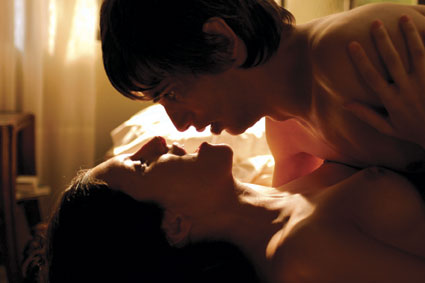
The nearly-full house at yesterday’s screening of Don’t Look Down (Argentina; 2008, 85 min, 35mm) challenged several clichés about U.S. movie audiences. Namely, they seemed perfectly comfortable with its joyous depictions of explicit sex, and when they laughed during these scenes (which was often), it wasn’t nervous laughter, either. But this may be less indicative of Chicago’s good vibes than of the strengths of Don’t Look Down—a rare film that manages to be funny and erotic at once.

At the outset, writer-director Eliseo Subiela doesn’t hint that his film will turn into a lesson in Tantric sex. The movie starts as a charming story about Eloy, a 19-year-old eccentric who works odd jobs and has crazy dreams about his dead father. (One of these dreams—unexplained until much later—has the father slowly emptying nuts and bolts from his suit pockets. The image plays as a wry parody of art-house cinema, and it got one of the bigger laughs of the day.) In one of many unpredictable turns, Eloy becomes a sleepwalker. He winds up one night in the apartment of an old lady therapist and her granddaughter, Elvira. Instead of kicking him out, the women take a liking to Eloy, with the beautiful, Gypsy-ish Elvira (who’s nine years his senior) deciding to make him a great lover by the end of the summer.


This premise verges on teenage male fantasy, but Subiela makes clear that the sex is not about Eloy’s gratification only. As in the classic comedies by Dusan Makavejev—particularly W.R. Mysteries of the Organism (1971)—sex is presented as life-affirming for anyone who enjoys it. (There’s another weird plot twist later on in which Eloy finds himself literally dematerializing at orgasm, but he makes sure not to deny Elvira pleasure before he does.) The film’s conflation of dreams, character quirks, music and eroticism yields a sensibility overflowing with life. Granted, this should feel familiar to anyone who’s read Gabriel Garcia Marquez or any other of the great South American Magical Realists. But how refreshing it is to encounter it in an accessible, crowd-pleasing film. Don’t Look Down also doubles as an instruction guide to more than a dozen challenging positions from the Kama Sutra. As our society enters a depression and more people will have to “make their own fun” (as my grandparents used to say), perhaps Subiela’s film will prove a rather utile one in the coming years.

Another film that conflates societal and sexual awareness is one of CIFF’s French entries, Born in ’68, by the writing-directing team of Olivier Ducastel and Jacques Martineau (who are best known for their Jacques Demy tribute Jeanne and the Perfect Guy [1998]). As the title suggests, the movie begins with a look at France’s revolutionary/utopian generation before moving forward through the next four decades. The early passages depict an idealistic group’s efforts at establishing a commune in the French countryside—with as many scenes of free love as of farming. It’s hard to think of many other films that stage group sex with this much tenderness, and the most commendable thing about Born in ‘68 is its rich sensitivity. (Similarly, the large ensemble cast has no weak link—especially impressive, as many of the actors have to age believably over 40 years.) But apart from Ducastel and Martineau’s daring choice to shoot so much of a period piece in Bergman-esque close-up, much of the film comes across as a retread of Lukas Moodyson’s Together (2000), John Sayles’ Return of the Secaucus Seven (1980), Alain Berliner’s classic Jonah Who Will Be 25 in the Year 2000 (1976), and other like-minded works. It much follows the now-familiar pattern of Leftists coming together to make good, falling apart, and then finding comfort in some modified version of their ideals. Not that this is necessarily a bad message (It’s especially valuable to hear in the United States as a corrective to the conservative propaganda of Forrest Gump [1994] and Oliver Stone’s ‘60s-set films), but it’s hard to say whether it merits a full three hours of attention. Still, Born in ’68 is a surprisingly leisurely three hours, and the confidence of its storytelling never bores.

Saturday, October 18, 2008

Notes from last night's screening of HAPPY-GO-LUCKY


The CIFF screening of Happy-Go-Lucky (2008) last night in anticipation of its release later this month (Oct. 24) served a twofold purpose: to present Mike Leigh with a career achievement award and to offer Chicago audiences their first opportunity in a long while to engage the great British filmmaker.

First, on the award. Festival director Michael Kutza commented that Leigh's first film, Bleak Moments (1971), won CIFF's Golden Hugo back in 1972. Gracious, Leigh said the career achievement award was "very special indeed", adding, "It's as if I've come full circle, though I hope it's not the end of the circle!"

Leigh then sat down for a Q&A with Tribune critic Michael Phillips. The proceedings were lively, to say the least. Audiences were clearly stunned by Leigh's lucid and amicable approach. He was never disengaged for a moment, even (you could say especially) when faced with a myriad of confused questions.

Happy-Go-Lucky was described by its director as "a story about being connected to your feelings and integrity", an "anti-miserabilist film". This commentator, for one, was grateful to see Leigh address world issues right off the bat. "There's a great deal for us to be gloomy and pessimistic about," Leigh explained, "I mean, we're suicidally destroying the planet!"

Getting back to the film, he summarized his point: "Happy-Go-Lucky is about a character getting on with it."

Indeed, Sally Hawkins' Poppy is that rare film heroine, a smart, disciplined woman with a career, dreams, and friends, but who unpretentiously floats from place to place and is content with the terms of each situation she encounters. If there's frivolity or dissatisfaction in her world, it's the others who see it and become the judges of Poppy's behavior. She has an unassertive wisdom and a heightened sense of awareness that places her on a different plain than virtually everyone she meets.

Poppy is one of the greatest film characters to emerge in the 21st century: a boisterously joyous and inventive elementary school teacher, she maintains the same free and unmournful approach throughout the film. "Teaching is an act of optimism," Leigh asserted last night, referring not just to Poppy, but also to the other teachers who dominate the film.

Teaching is the overarching subject of Happy-Go-Lucky; the characters comment on their own teaching and refer to the lessons of others. It's a critical dialogue that manifests itself with such a quiet ease that by the end of the film you leave the theater wanting to continue the discussion. A public school teacher in the audience was so elated that she personally thanked Leigh.

Happy-Go-Lucky's most crucial interactions occur in the confined space of a Ford Focus. Hawkins' Poppy and Eddie Marsan's Scott are perfect opposites. He's a peppery driving instructor who won't conform to Poppy's apparent lack of seriousness. A viewer familiar with Abbas Kiarostami's Ten (2002), in which the Iranian director almost solely used two cameras in a cramped car as his entire visual design, might wonder if Leigh saw it prior to making Happy-Go-Lucky.

The two cameras, one angled toward the passenger seat, the other to the driver, impose a curious limitation on Leigh's luxurious palette of London vistas (he opens the film with an amazing shot by a train track worthy of Antonioni). He alternates the two angles in an almost rhythmic way. As in a John Cage composition, the tension in these rhythms becomes so rigid that it offers an appropriate visual parallel to Poppy and Scott's intensifying conflicts.

(For a more in-depth summary of the film's many characters and details, check out fellow CIFF blogger Marilyn Ferdinand's critique.)

A scene that will surely stand out to viewers has Poppy on a nocturnal tour where she encounters a stuttering man underneath what appears to be a bridge. This writer asked the filmmaker for his thoughts on it, describing it as a moment that felt as if it had snuck away from Leigh's own Naked (1993). "It's a scene from the film Happy-Go-Lucky," Leigh retorted, but conceded, "I'm not surprised you would say that." Speaking of his intentions, Leigh said, "We wanted to subliminally pull the audience out of their comfort zone in that scene."

It's a key instant to understanding Poppy, something Leigh confirmed: "It's about her openness, her natural ability to connect. She's going to move on; the man, unfortunately, won't." Leigh even emphasized the film's own afterthought of the scene: "When she goes home, Zoe [her roommate] asks her where she's been and she doesn't respond. She keeps the moment private."

These dynamic shifts in the film are masterfully integrated, and it only takes a careful viewing to see this. A rambling audience member, stroking his sideburns and looking distractingly around the room as he told the filmmaker (and us) that he thought the ending didn't exactly summarize the film in a satisfying way had Leigh responding thusly: "Yeah, you're trying to say it's maybe too neat and tidy. Okay, that's a fair criticism."

What a gentleman. The rest of the festival will certainly have a hard time living up to this magical evening.

Winged Idiots and Wordless Angels


Idiots and Angels (2008) screens tonight at 10:30pm, Tuesday (10/21) at 6:30pm, and Wednesday (10/22) at 7pm. Director Bill Plympton will be present for the Tuesday and Wednesday screenings.

Veteran animator Bill Plympton's latest uses a clichéd noir setting and a catalogue of hard-boiled genre characters to tell the rather unique story of a pathologically unfriendly man named Angel who unexpectedly grows a pair of heavenly wings. Unlike his last feature, Hair High (2004), which used the voices of Sarah Silverman, Dermot Mulrony and others, Idiots and Angels is completely wordless (if you don't include the Tom Waits waltz that's included towards the end of the film).

The question on fans' minds will be whether Plympton can sustain the same level of interest at seventy-eight minutes as in his similarly styled shorts. There's something kind of overwhelming yet cleverly executed about Idiots and Angels that doesn't exhaust the viewer. Call it a sort of formalism, but the imagination the film displays always leaves some room for further reflection. It's a counter-intuitive animated film, in which images can be contemplated and don't have to be immediately understood.

Consequently, there isn't anything very animated about it in the general sense. It takes place mostly in dreary settings -- grimy bars, small bathrooms, doctor offices -- where the only thing a spectator is tempted to contemplate is the flurry of wobbly pencil sketches (it's especially impressive to see on the big screen). Also, Plympton would rather show us the characters react to each other blankly -- a technique that finds its closest equivalent in the films of Aki Kaurismäki.

The point of view is always an unexpected one -- whether it's from a butterly flying around or inside the mouth of a protagonist as he downs a whisky shot -- and keeps us from fully settling in. It's uncomfortable at first but makes sense when you realize that Plympton may be using these inventive digressions as a way of distancing himself from the moral world of these characters.

The title refers to idiots and angels, plural, though there is really only a single person in the film who safely fits into the angel profile. This is a direct indication of Plympton's generosity towards the material. All of his characters are idiots and angels; he never shows a world that is better, with characters that are nicer or more virtuous in their deeds.

Finally, when someone violently appropriates Angel's wings, we realize he may have done the same in a like scenario. Does the film offer a catharsis, a sense of growth in these characters that we end up feeling a pang of regret for Angel? The wings try to guide him but Angel's journey remains ambiguous.

Kelly Reichardt's WENDY AND LUCY


Wendy and Lucy screens today, 10/18, at 600 North Michigan at 6:10pm.


I was lucky to obtain the last ticket to Friday’s screening of Wendy and Lucy, which will likely sell out again tonight. Reichardt’s film is set to receive a wider release soon, but it seems like the optimal experience would be seeing it with a full house that doesn’t know just what to expect. The subject is homelessness in the United States, but Reichardt avoids any systemic judgments: Like many great political films before it, Wendy and Lucy focuses on specific moments that reframe “issues” as human experiences. The film observes a few days in Wendy’s life as her car breaks down in small-town Oregon and things go from bad to worse. Some critics have accused Michelle Williams as being too pretty a choice to play Wendy, but that seems like part of the movie’s point: Poverty can fall upon anyone with bad enough luck, not just people who “look” homeless. Wendy’s relationship with her dog Lucy—the one thing that keeps her going, much like Umberto D.’s immortal love for his Flag—further humanizes the situation, as does Reichardt’s eye for Oregonian life. The film has a heartfelt, handmade look to it (which often feels like 16-millimeter, even though it was shot on 35), which makes this one of the best pieces of regional American filmmaking since Julian Goldberger’s The Hawk is Dying (2006). (2008, 80 min 35mm)

From Chile: THE SKY, THE EARTH AND THE RAIN


The Sky, the Earth and the Rain screens today, 10/18, at 600 North Michigan at 3:20pm, and on Monday 10/20, 4:00pm.

José Luis Torre Leiva’s
The Sky, the Earth and the Rain boasts the year’s most awesome sound design and some of the most unforgettable images as well. Unfortunately, it’s cursed with a generic, uninformative title—which may explain why last night’s prime-time screening was so sparsely attended. But this is the sort of movie that international festivals were all but made for. It provides a window on an unfamiliar part of the world (a small island town off the coast of Chile) and operates in a tempo unfamiliar to most cosmopolitan viewers. The minimal story focuses on Ana, a reticent young woman who cares for her bedridden mother. For a while, she works at her island’s general store, but then she signs on as a maid for a single man who owns an apple orchard. That’s about it as far as the plot goes, but Torre Leiva makes every moment resonate: His meditative tracking shots and breathtaking Dolby soundtrack envelop the audience in natural spectacle. (Last night’s audience, who quite didn’t know what it was getting into, was brought to reverential silence about 15 minutes in.) Torre Leiva cribs a few shots from Andrei Tarkovsky’s classic The Mirror (1975), but not superficially. Indeed, The Sky, the Earth and the Rain is one of the few films since Tarkovsky’s passing that seriously contemplates nature as a living thing. This is a movie to get lost in. (2008, 110 min, 35mm)